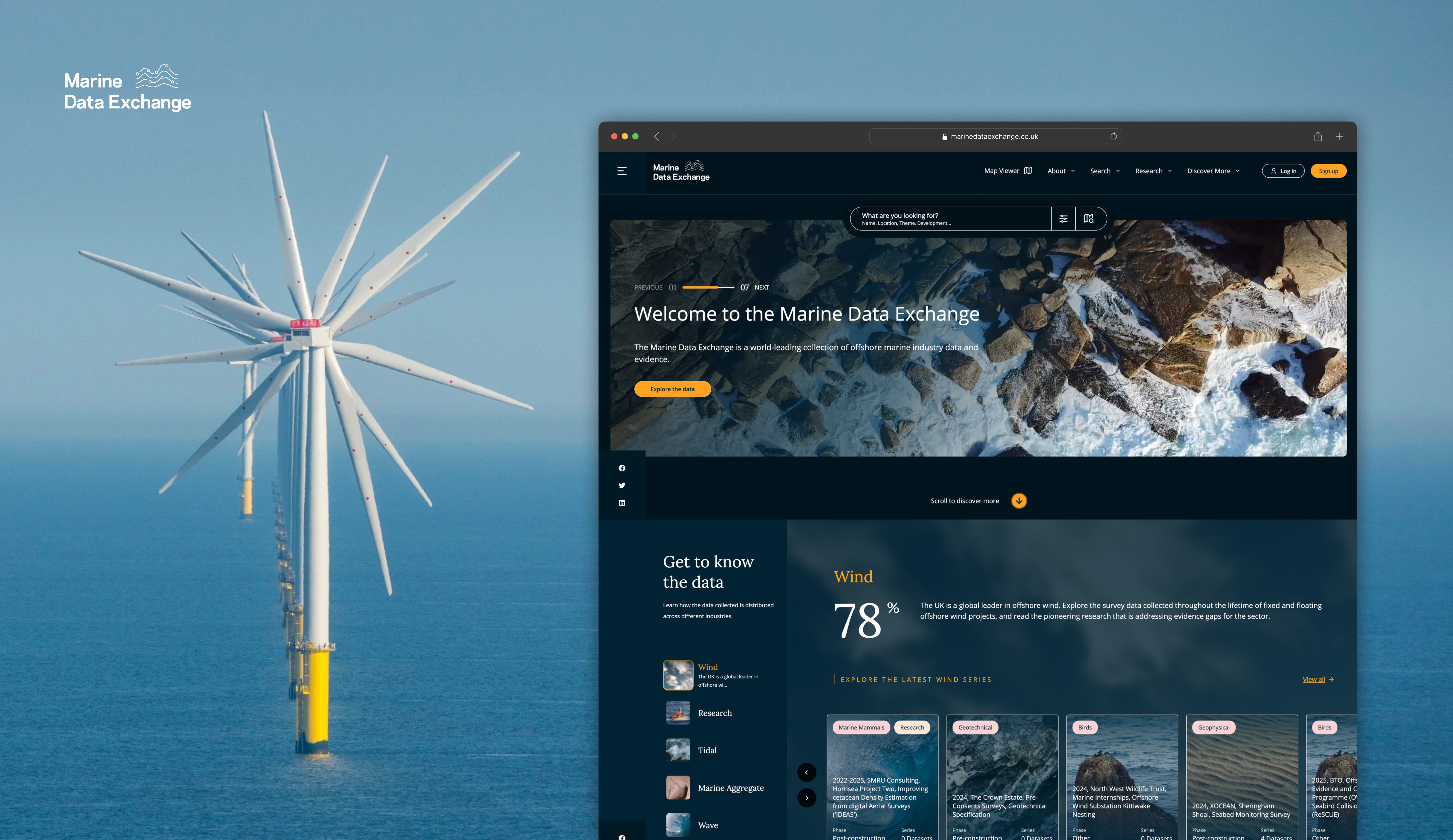
The Marine Data Exchange (MDE) is the world’s largest collection of offshore marine data, managed by The Crown Estate. It provides open access to data collected during the planning, construction, and operation of offshore renewable projects across the UK seabed.
Despite its importance, the platform’s experience had become outdated, with fragmented navigation, inconsistent search results, and limited trust in data accuracy. The redesign aimed to modernise the experience, improve data discoverability, and enhance credibility among both data providers and research users.
Role:
Lead UX Designer
Team:
UX Designer, UI Designer, PM, Front-End and Back-End engineers, Client Stakeholders
Platforms:
Web
Duration:
4 months
The Problem
Despite its value, the platform no longer met the needs of its two main user groups:
Industry contributors, responsible for uploading large, compliant datasets.
Government and academic researchers, relying on the data for verified marine insights.
Both groups faced friction and uncertainty.
Search was inconsistent, uploads complex, and metadata unclear.
Many users bypassed the system entirely, relying instead on internal contacts or third-party sources to access what they needed.
Key challenges:
Unclear data hierarchy and inconsistent labelling.
Fragmented, error-prone upload process.
Low confidence in search accuracy and metadata validity.
Research Insights
To understand how users interacted with the MDE, I worked closely with The Crown Estate’s research and product teams to map behavioural patterns, uncover technical barriers, and identify opportunities to rebuild trust through UX design.
Key findings showed that:
Search precision drives trust. Users were frustrated by repetitive keyword filtering and inconsistent results.
Metadata clarity builds confidence. Without visible provenance, users questioned dataset reliability.
Structured upload support reduces errors. Contributors needed clearer validation aligned with MEDIN standards.
These insights shaped the UX roadmap and guided the redesign around three principles: clarity, credibility, and reassurance.
Process & Roadmap
To align stakeholders early, I created a UX roadmap defining every discovery activity, from stakeholder interviews to final personas. This helped validate assumptions, prioritise user needs, and establish a shared understanding of where design could have the greatest impact.
Discovery Phase Roadmap
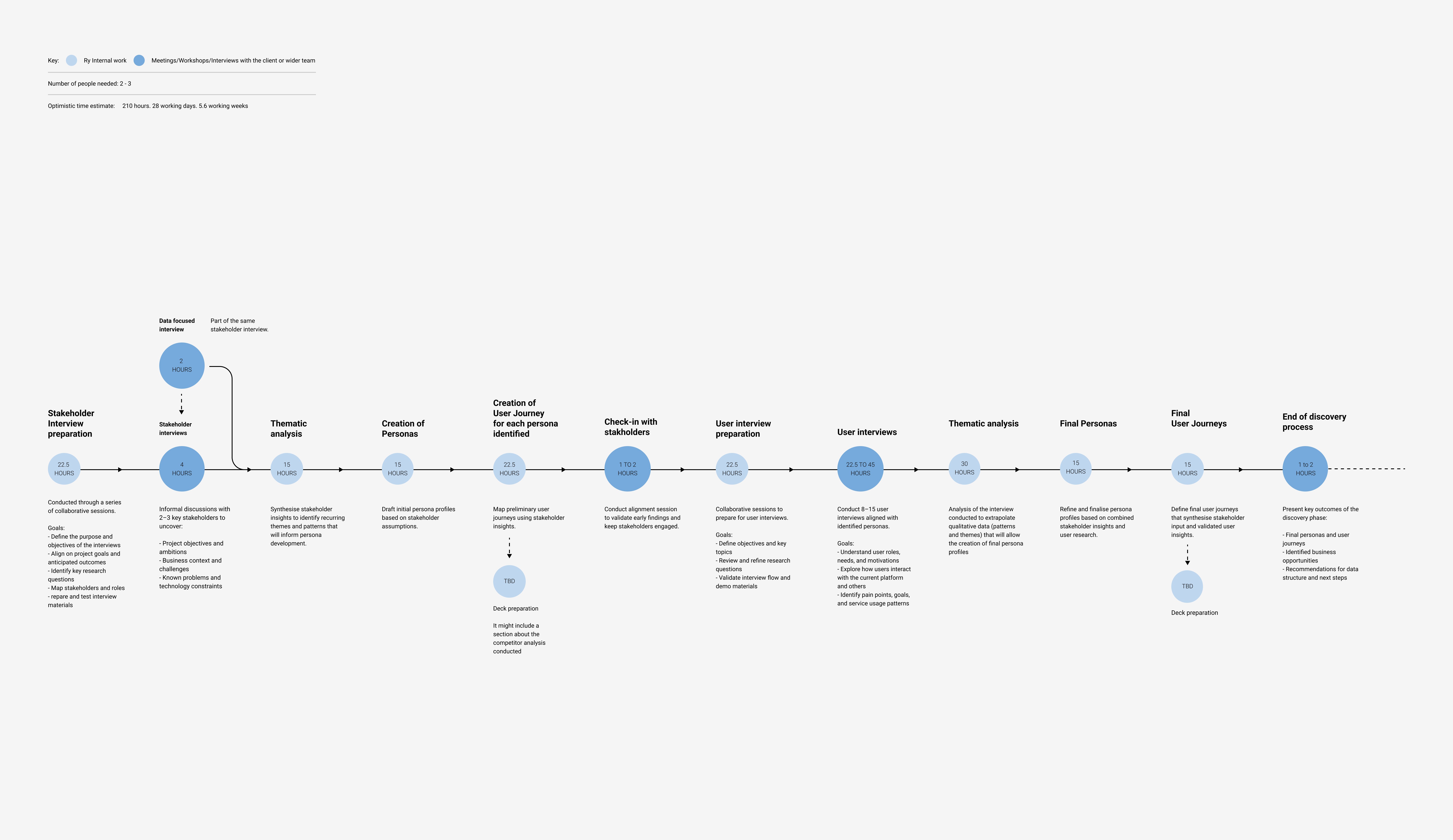
Timeline of UX activities showing how stakeholder interviews, thematic analysis, and user research informed early design decisions.
User Personas: Industry & Research Profiles
Two core personas emerged from the research, reflecting opposing user needs across the data ecosystem: data uploaders seeking structure and researchers seeking reliability.
Personas
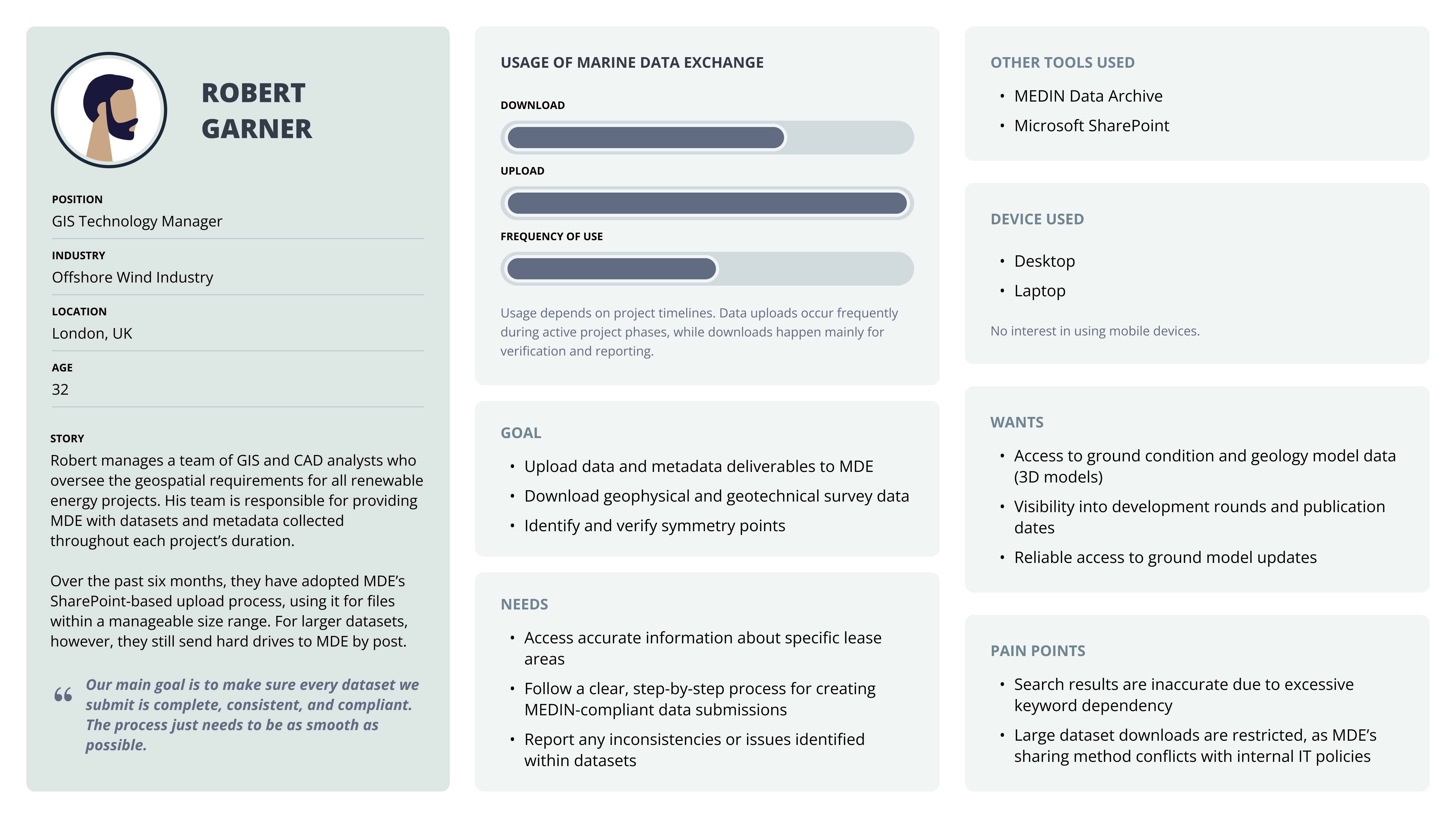
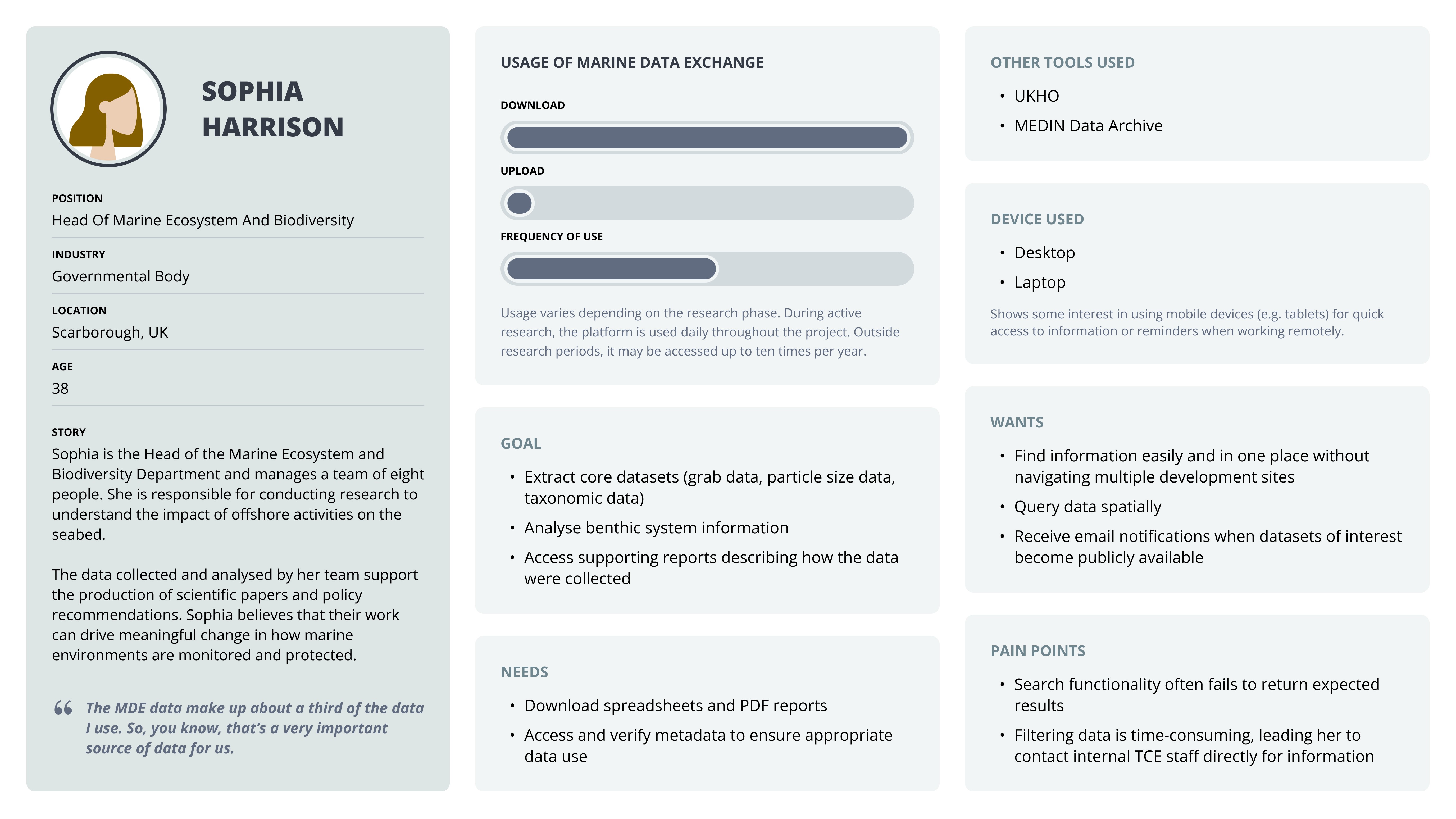
Representative personas capturing the contrasting goals, workflows, and frustrations of MDE’s primary users.
User Journeys
Mapping their journeys revealed key friction points in upload, search, and retrieval, which later informed the new IA and guided upload flow.
User Journey Maps: Uploading and Discovering Data
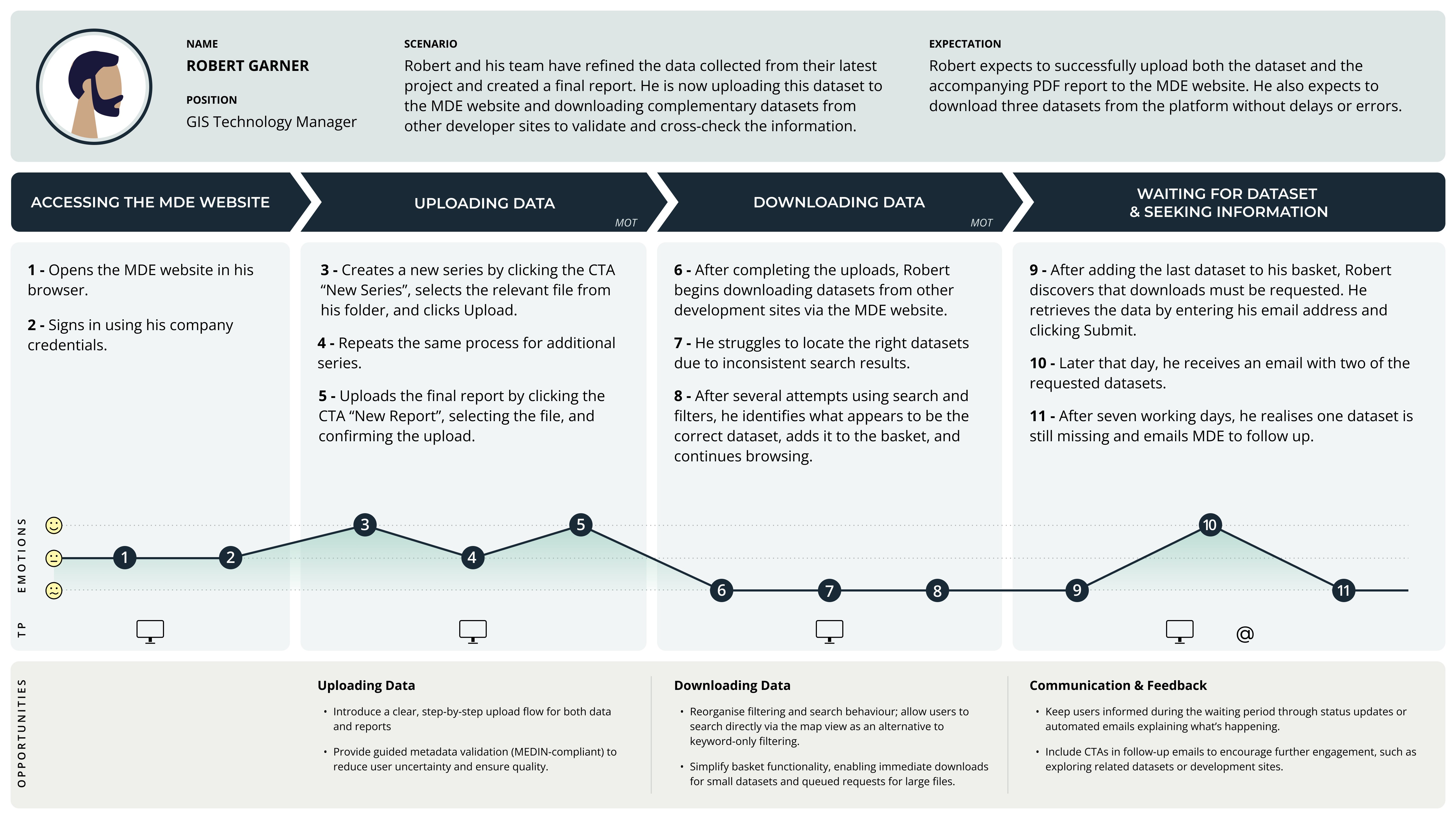
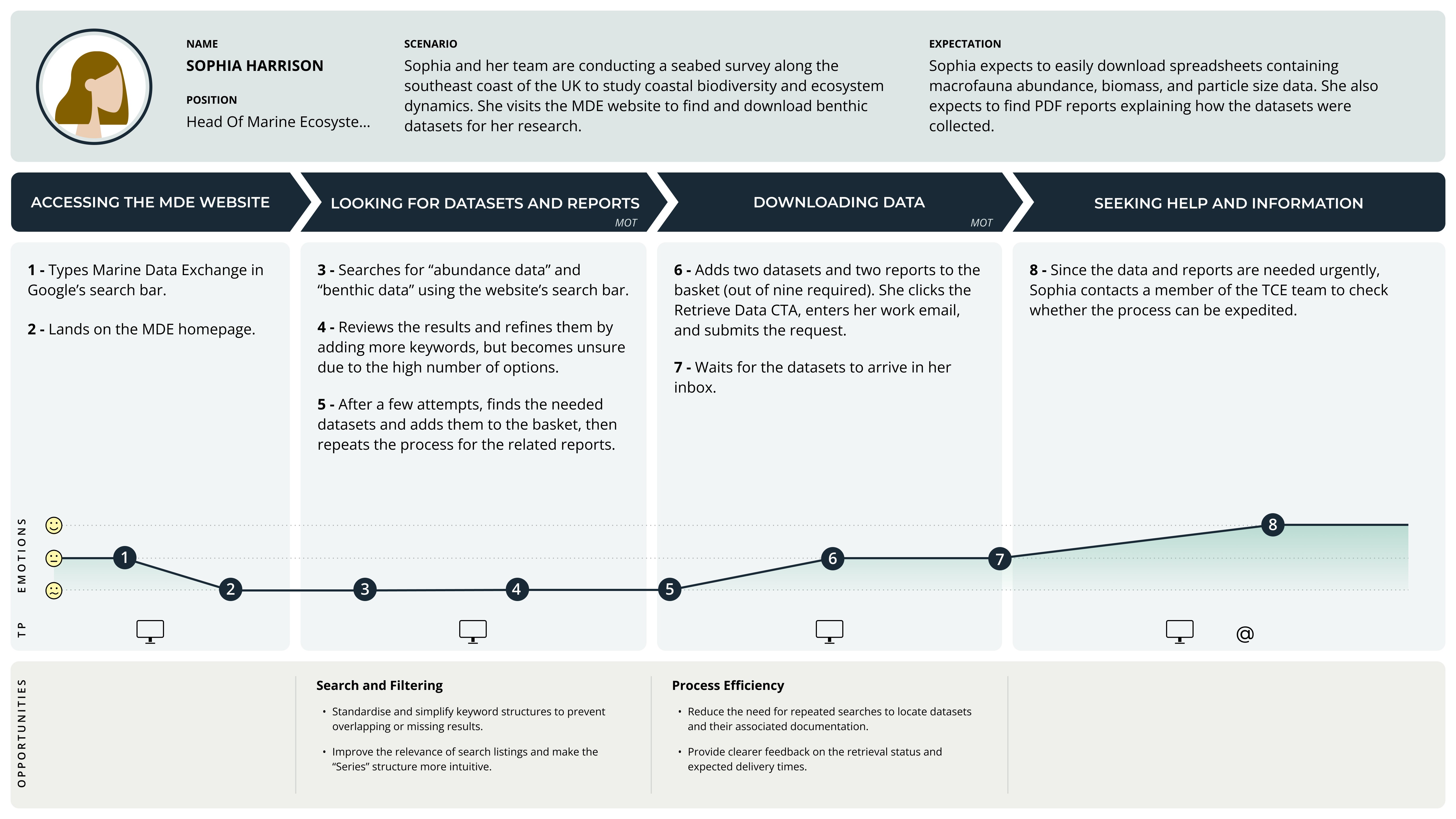
Journey maps of Robert (Industry Contributor) and Sophia (Researcher), showing pain points, emotional peaks, and UX opportunities across key workflows.
The design phase focused on turning research findings into a clear UX framework that improved structure, trust, and discoverability.
Partnering with The Crown Estate’s product and data teams, I defined how MDE should organise, visualise, and validate marine datasets across the full user journey.
Structure & Navigation Framework
Reorganised the platform around user intent rather than internal taxonomies.
Created a navigation system centred on three key user goals: finding, understanding, and validating data, providing clear pathways through complex information.
This framework established consistent metadata patterns and reduced reliance on domain knowledge to locate datasets.
Upload Flow Blueprint
Mapped a simplified, step-by-step upload experience compliant with MEDIN standards.
Introduced real-time validation and automated error prompts to prevent upload failures and reduce dependency on IT support.
This improved both efficiency and confidence among industry contributors.
Data Discovery
Redesigned the search and filtering model to make dataset discovery faster and more transparent.
Results were grouped by relevance and metadata completeness, helping users quickly identify credible sources.
Linked documentation and visual previews allowed researchers to verify context before downloading.
Mid-fidelity Wireframes
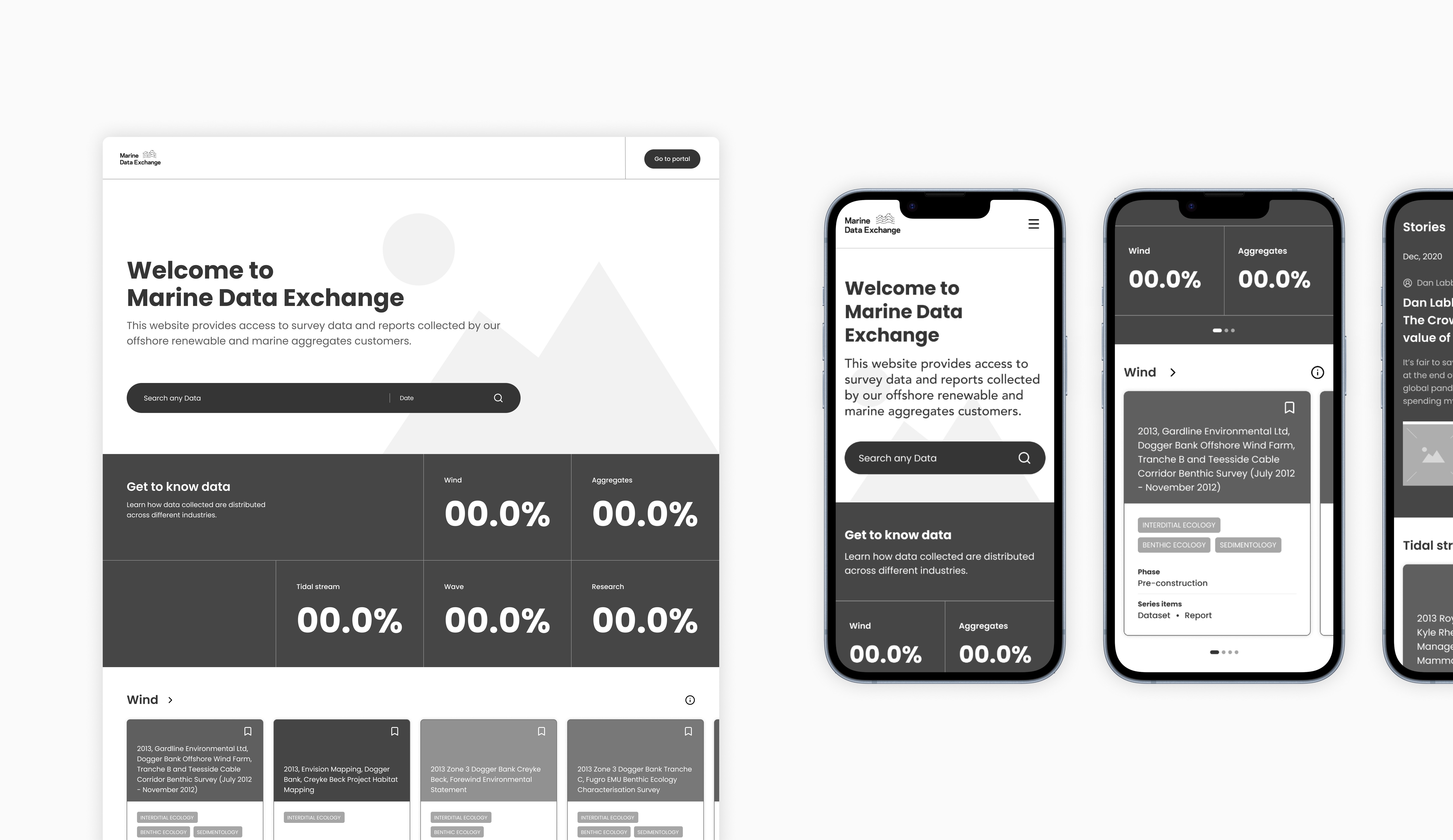
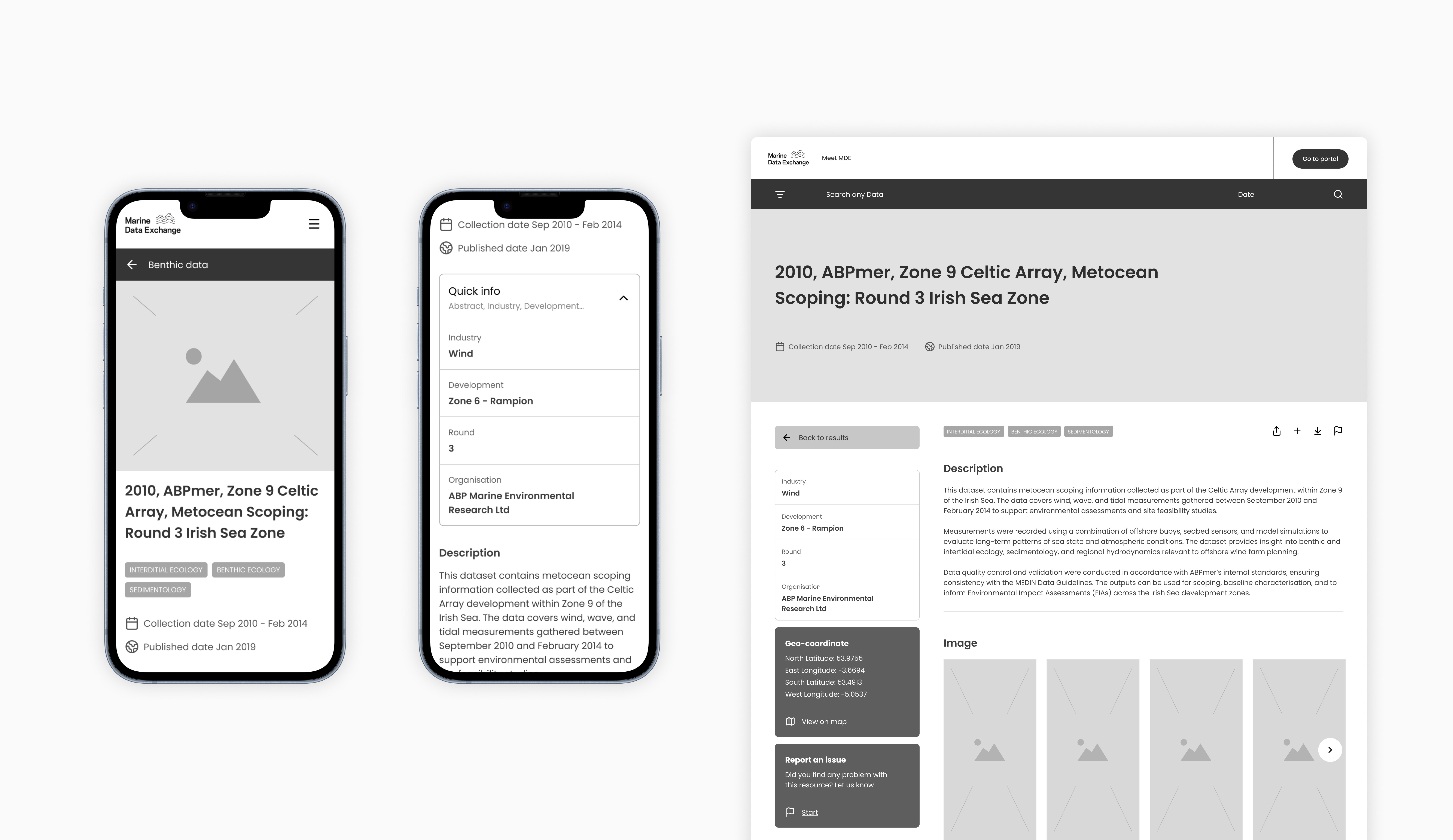
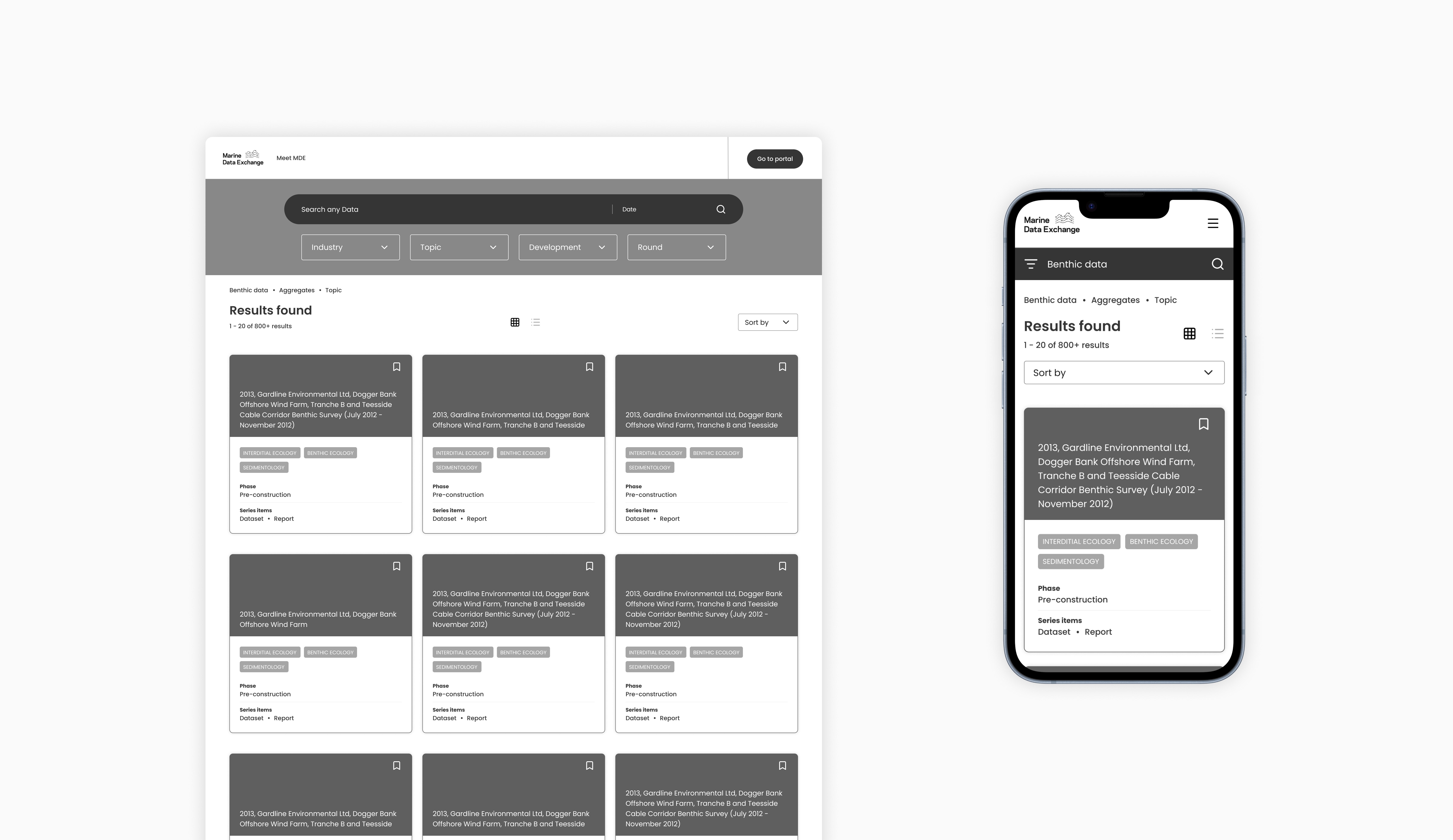
Desktop and mobile wireframes showcasing the redesigned homepage, dataset detail page, and search results view, illustrating improvements in structure, hierarchy, and data clarity.
Interactive prototypes were tested with internal Crown Estate teams and external researchers.
Sessions focused on how easily users could find, trust, and submit marine datasets across the new structure.
Results:
Users were able to locate datasets noticeably faster and with less reliance on internal contacts.
Metadata uploads became smoother and more accurate thanks to the guided validation process.
Researchers expressed greater confidence in the reliability of data and clarity of the navigation.
Feedback consistently highlighted improved clarity, trust, and efficiency, confirming that the redesign met its goal of making complex marine data accessible and dependable.
The redesigned Marine Data Exchange created a more transparent and efficient platform for The Crown Estate’s data contributors and research partners.
Outcome:
1
Reduced reliance on manual support by making upload and validation self-sufficient.
2
Improved discoverability and comprehension of marine datasets through clearer navigation and metadata structure.
3
Strengthened user trust in open data, supporting The Crown Estate’s long-term goal of promoting environmental research and accountability.